Google Rankings Definitely Impact Dance School Enrollment and Revenue – Here’s the Data
Real industry CTR benchmarks show exactly how AI results, Google Maps rankings, and organic search positions affect paying students and revenue.
As a dance studio owner, you know that every new student counts. But are you maximizing your online visibility?
Ranking higher in Google—through AI Overviews, the Map Pack, and organic search—can directly boost your enrollment and revenue.
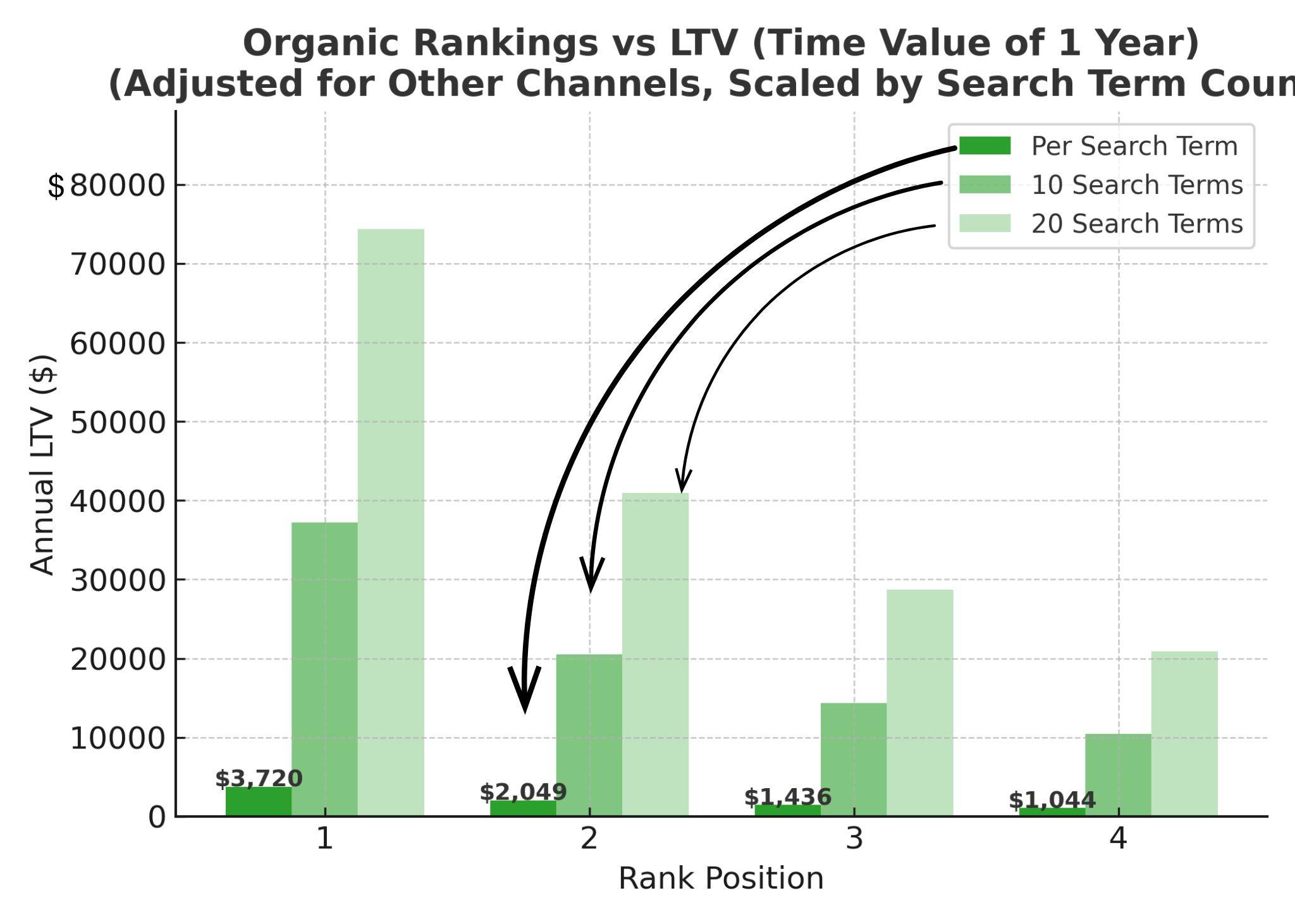
In this page, I break down how much each ranking channel can realistically contribute using national CTR benchmarks, conservative conversion assumptions, and real-world seasonal adjustments. You’ll see not only the potential lift from a single high-intent search term, but also how that impact multiplies across a suite of key phrases like “ballet classes near me,” “beginner hip hop,” or “children’s dance lessons "dance classes for adults.”
Dive into actionable data designed to help you plan smarter, grow faster, and turn search rankings into paying students.
See the Numbers: How Moving Up in Google Rankings Can Add Thousands to Your Dance School’s Annual Revenue


Frequently Asked Questions
- BrightEdge 2024 AI Search Impact Report (AI Overview CTRs)
- BrightLocal 2024 Local Search Behavior Study (Google Maps/Local Pack CTRs)
- SISTRIX 2023 Organic CTR Study (traditional search listings)
- Search volume: 500 monthly searches per high-intent search term
- Click-to-paid conversion rate: 3%
- Tuition: $100/month per student
- Retention: 12 months (1-year LTV)
- Seasonality: 50% drop in new enrollments in July & August
- National average click share for that channel and rank
- 500 searches/month for that keyword
- 3% click-to-paid conversion rate
- $100/month tuition × 12 months retention
- 50% summer enrollment drop in July and August
- Adjusted for AI and Maps taking clicks before Organic
Most successful dance schools rank for dozens of money-making search terms like:
- “ballet classes for adults”
- “children’s ballet classes”
- “hip hop dance classes near me”
- “tap dance lessons”
- “beginning ballet classes”
- We started with national average click-share when all three are present
- AI Overview: 28% of all clicks
- Map Pack: 22% of all clicks
- Organic: 50% of all clicks
That 50% for Organic is not its “standalone” CTR — it’s after AI and Maps have siphoned away 50% of the total clicks at the top of the SERP. - We then split that 50% Organic share across ranks 1–4 using SISTRIX’s organic CTR curve.
- Organic #1 gets ~57% of that Organic share (so ~28.5% of total clicks).
- Positions 2–4 get proportionally less.
- This means Organic #1’s value here is already suppressed compared to an “Organic-only” page, because it’s working with a smaller piece of the click pie.
- In a “pure” SERP without AI or Maps, Organic #1 would be worth far more.
- In our model, it’s competing for attention below AI and Maps, exactly as in a real search result.
- Users disproportionately click the first thing they see on the SERP (Search Engine Results Page).
- The higher a result appears on the page — especially above the fold — the more clicks it gets.
- This is exactly why AI Overviews and Map Packs siphon so much traffic from Organic results: they sit above them and visually dominate the top of the page.
- Not everyone clicks the very first item — some scan multiple results.
- But the CTR drop-off is steep as you move down the page.
- That’s why, in our model, Organic rankings have a smaller share when AI and Maps are present, because their position pushes them lower.
About the author
This analysis was prepared by Steven Chayer, co-owner of the American Dance Institute and SEO strategist for dance schools nationwide. Steven’s work has helped ADI grow to over 1,000 active students and achieve #1 rankings for Seattle’s most competitive dance school keywords.
https://www.americandanceinstitute.com/about-us-seo-for-dance-schools/
Frequently Asked Questions
- BrightEdge 2024 AI Search Impact Report (AI Overview CTRs)
- BrightLocal 2024 Local Search Behavior Study (Google Maps/Local Pack CTRs)
- SISTRIX 2023 Organic CTR Study (traditional search listings)
- Search volume: 500 monthly searches per high-intent search term
- Click-to-paid conversion rate: 3%
- Tuition: $100/month per student
- Retention: 12 months (1-year LTV)
- Seasonality: 50% drop in new enrollments in July & August
- National average click share for that channel and rank
- 500 searches/month for that keyword
- 3% click-to-paid conversion rate
- $100/month tuition × 12 months retention
- 50% summer enrollment drop in July and August
- Adjusted for AI and Maps taking clicks before Organic
Most successful dance schools rank for dozens of money-making search terms like:
- “ballet classes for adults”
- “children’s ballet classes”
- “hip hop dance classes near me”
- “tap dance lessons”
- “beginning ballet classes”
- We started with national average click-share when all three are present
- AI Overview: 28% of all clicks
- Map Pack: 22% of all clicks
- Organic: 50% of all clicks
That 50% for Organic is not its “standalone” CTR — it’s after AI and Maps have siphoned away 50% of the total clicks at the top of the SERP. - We then split that 50% Organic share across ranks 1–4 using SISTRIX’s organic CTR curve.
- Organic #1 gets ~57% of that Organic share (so ~28.5% of total clicks).
- Positions 2–4 get proportionally less.
- This means Organic #1’s value here is already suppressed compared to an “Organic-only” page, because it’s working with a smaller piece of the click pie.
- In a “pure” SERP without AI or Maps, Organic #1 would be worth far more.
- In our model, it’s competing for attention below AI and Maps, exactly as in a real search result.
- Users disproportionately click the first thing they see on the SERP (Search Engine Results Page).
- The higher a result appears on the page — especially above the fold — the more clicks it gets.
- This is exactly why AI Overviews and Map Packs siphon so much traffic from Organic results: they sit above them and visually dominate the top of the page.
- Not everyone clicks the very first item — some scan multiple results.
- But the CTR drop-off is steep as you move down the page.
- That’s why, in our model, Organic rankings have a smaller share when AI and Maps are present, because their position pushes them lower.
Let's Chat, No Sales, No Pressure
Call Me Now, dial 206-433-1750.